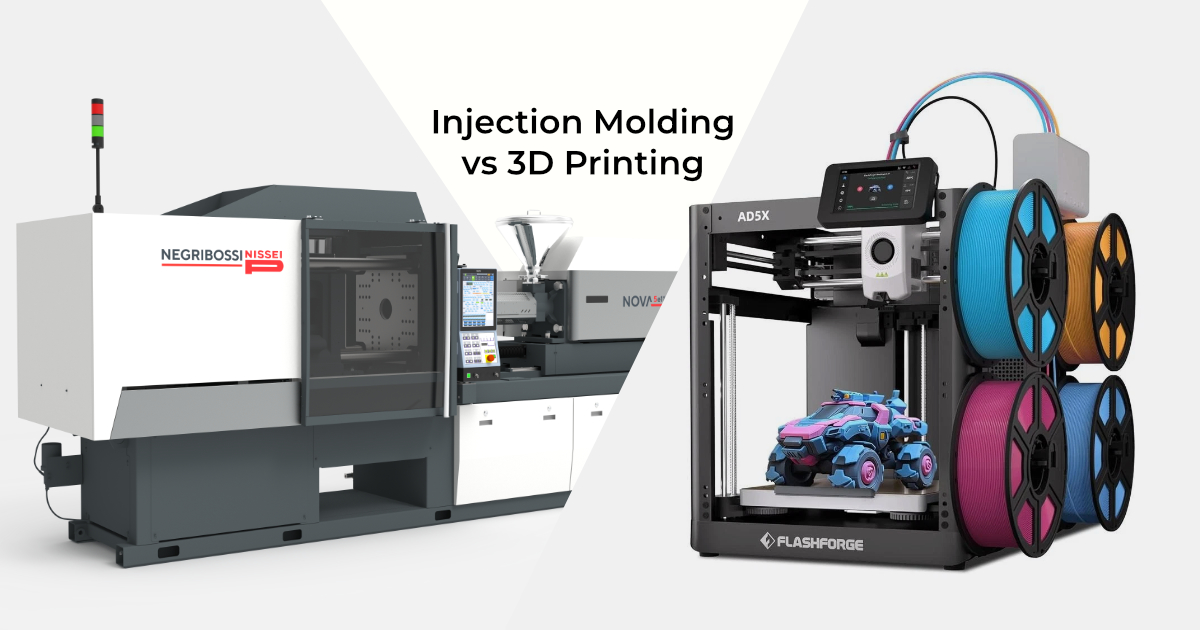
Injection Molding vs 3D Printing: Which Is Right for Your Project?
The choice between injection molding and 3D printing is one of the most common questions product engineers face when moving from design to production. The right answer depends on where you are in the product lifecycle, how many parts you need, and what performance you require. Here’s a practical framework for making the decision.
The Short Answer
Use 3D printing for: Prototypes, design validation, single-digit quantities, complex geometries that can’t be molded.
Use injection molding for: Production quantities above ~500 pieces, parts requiring tight tolerances, standard engineering resins, and consistent quality at scale.
For most hardware products, the manufacturing journey is: 3D print → validate → injection mold.
Cost Crossover Point
The economics of each process look very different:
- 3D printing: Zero tooling cost, high per-part cost that stays high regardless of volume
- Injection molding: High tooling cost (one-time), very low per-part cost that falls with volume
The crossover point — where injection molding becomes cheaper overall (tooling + parts) than 3D printing — typically occurs at:
- Simple small parts: ~300–500 pieces
- Medium complexity parts: ~500–2,000 pieces
- Large or complex parts: ~1,000–5,000 pieces
Beyond the crossover, injection molding saves money on every single part. For a product selling 50,000 units, the tooling cost is typically recovered within the first 2,000–5,000 units.
Detailed Comparison
| Factor | Injection Molding | 3D Printing (FDM/SLS) |
|---|---|---|
| Tooling cost | $2,000 – $50,000+ | None |
| Per-part cost (1,000 pcs) | $0.20 – $5 | $5 – $50 |
| Per-part cost (100,000 pcs) | $0.05 – $1 | $5 – $50 |
| Lead time (first parts) | 4–8 weeks | Hours to days |
| Dimensional tolerance | ±0.05mm (precision) | ±0.1–0.5mm |
| Surface finish | Excellent (Class A) | Visible layer lines |
| Material options | 500+ engineering resins | Limited to printable grades |
| Part strength | Isotropic (uniform) | Anisotropic (weak in Z) |
| Consistent repeatability | Excellent | Good (varies by machine) |
| Minimum wall thickness | ~0.8mm | ~1mm (FDM), ~0.4mm (SLS) |
| Maximum part size | Up to 1,500mm+ | Printer bed size |
| Best volume | 1,000 – 10M+ | 1 – 1,000 |
Where 3D Printing Wins
Prototyping Speed
From design to physical part in 24–48 hours. This speed is irreplaceable during early design iteration, when you may be testing multiple design variants before committing to tooling.
Complex Internal Geometry
Parts with internal channels, lattice structures, or organic shapes that can’t be de-molded (no parting line or draft possible) are natural candidates for additive manufacturing.
Very Low Quantities
For fewer than 500 pieces — or for spare parts programs where demand is low and unpredictable — 3D printing avoids a large upfront tooling investment for uncertain return.
Design Flexibility Without Penalty
Every design change to a 3D-printed part costs nothing. Every design change to an injection mold costs time and money. During active development, 3D printing gives you freedom to iterate.
Where Injection Molding Wins
Production Volume Economics
At scale, injection molding produces parts at a fraction of 3D printing cost. This advantage compounds with volume — a 500,000-unit product line will have a per-part cost in injection molding that is 50–200× cheaper than any additive alternative.
Material Performance
Injection-molded parts use the same engineering resins as specified — ABS, PC, PA66, POM — processed under controlled conditions. 3D printing in “equivalent” materials often delivers significantly lower mechanical performance (particularly in the Z direction for FDM).
Surface Finish and Cosmetic Quality
Injection-molded Class A surfaces — from SPI A1 mirror polish to fine VDI textures — cannot currently be matched by 3D printing without extensive post-processing. For consumer products where aesthetics matter, this is decisive.
Tight Tolerances
For parts that mate with other components (snap-fits, bosses, port cutouts), injection molding achieves ±0.05mm routinely. 3D printing tolerance is typically ±0.1–0.5mm depending on technology and machine.
Material Diversity and Compliance
Need UL 94 V-0 flame retardancy? FDA-compliant resin? ISO 10993 biocompatibility? These material certifications exist for injection molding grade resins. 3D printing material compliance is narrower and more expensive.
The Hybrid Approach: Bridge Tooling
For teams that need real production-quality parts sooner than a full production mold allows, bridge tooling offers a middle path:
- Aluminium tooling — lower tooling cost ($1,000–$5,000), faster lead time (10–15 days), shorter tool life (10,000–20,000 shots)
- Soft P20 steel tooling — moderate cost, 50,000 shot life, production-representative quality
Bridge tooling produces injection-molded parts in the actual production resin, giving real data on part performance — while the production mold is designed and machined in parallel.
Decision Framework
Use this checklist to decide:
| Question | Injection Molding | 3D Printing |
|---|---|---|
| Need parts in < 2 weeks? | ❌ | ✅ |
| Volume > 1,000 per year? | ✅ | ❌ |
| Requires Class A cosmetic finish? | ✅ | ❌ |
| Part has internal undercut channels? | ❌ | ✅ |
| Standard engineering resin required? | ✅ | Depends |
| Design still changing frequently? | ❌ | ✅ |
| Tight tolerance (< ±0.1mm)? | ✅ | ❌ |
Summary
3D printing and injection molding are not competitors — they are tools for different stages of a product’s lifecycle. Start with additive manufacturing to validate your design quickly and cheaply, then transition to injection molding when you have a validated design and a volume that justifies tooling investment.
If you’re at the transition point — designs validated, volume confirmed — JBRplas offers free DFM review to help you move from print to mold without costly redesign surprises.