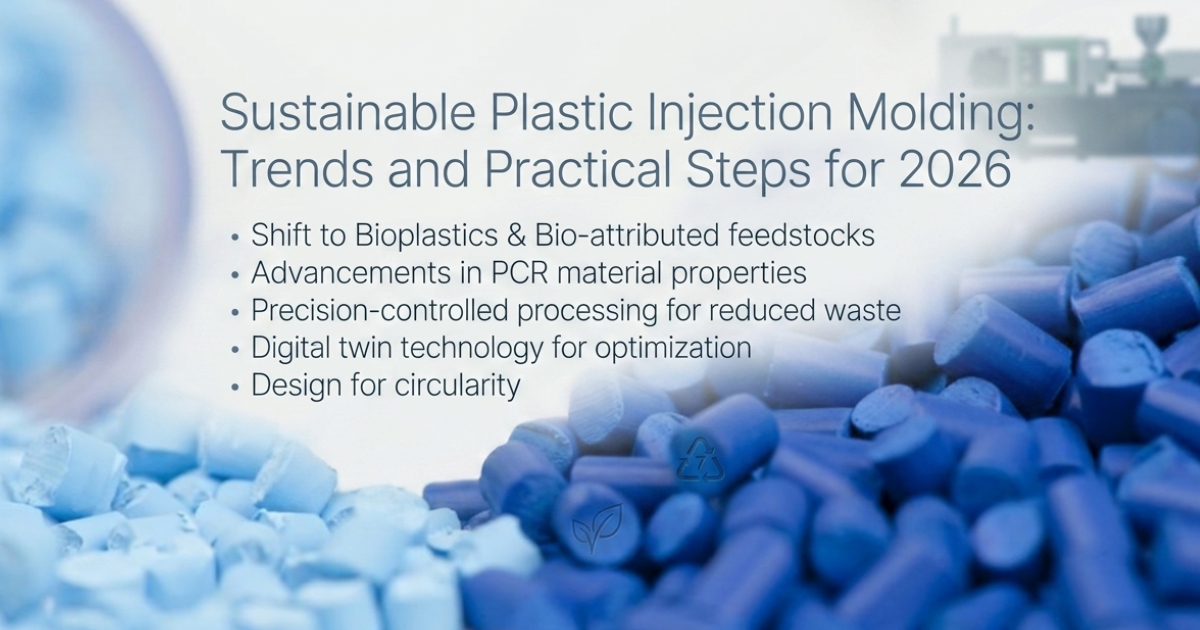
Sustainable Plastic Injection Molding: Trends and Practical Steps for 2026
Sustainability in manufacturing is no longer a marketing checkbox — it is increasingly a procurement requirement, a regulatory obligation, and a cost driver. For companies sourcing plastic injection-molded components, understanding what is practically achievable in the supply chain today — and what is marketing noise — is essential.
This article focuses on real, implementable sustainability improvements in plastic injection molding, not aspirational concepts.
1. Post-Consumer Recycled (PCR) and Post-Industrial Recycled (PIR) Resins
What’s Available
The use of recycled plastic content in injection molding has grown substantially as major brands commit to recycled content targets. Two categories are relevant:
Post-Consumer Recycled (PCR): Plastic collected from end-of-life consumer products — bottles, packaging, electronics. PCR PP and PCR HDPE are the most widely available and processable. PCR ABS and PCR PC are emerging.
Post-Industrial Recycled (PIR): Off-cuts and sprues from manufacturing processes, reground and recompounded. Higher consistency than PCR; often used at 20–50% blend ratios with virgin material.
Performance Trade-Offs
| Property | Virgin Resin | PCR (20–30% blend) | 100% PCR |
|---|---|---|---|
| Tensile strength | Baseline | -3% to -8% | -10% to -25% |
| Colour | Consistent | Slight variation | Significant variation |
| Surface finish | Class A achievable | Class B typical | Class C (non-cosmetic) |
| Part-to-part consistency | High | Medium | Lower |
| Cost | Baseline | -5% to +10% | +5% to +20% |
PCR resins at 20–30% blend ratios in PP and ABS are processable with minimal performance impact for non-critical structural applications. For cosmetic or precision applications, higher PCR content requires material qualification testing.
Practical Recommendation
If your product has a recycled content target, specify it clearly on the BOM. Work with your injection molder to identify which part features are compatible with PCR content — non-cosmetic, non-structural, or over-molded components are the best starting point.
2. Bio-Based Plastics
Bio-based plastics are derived from biological feedstocks (sugarcane, corn starch, cellulose) rather than petroleum. The most relevant for injection molding in 2026:
PLA (Polylactic Acid)
- Derived from corn starch or sugarcane
- Commercially available and processable on standard injection molding equipment
- Limitations: low heat resistance (HDT 55–60°C), brittle, requires industrial composting for biodegradation (not home compostable despite common assumption)
- Best for: low-temperature applications, disposable medical devices, promotional items
Bio-PP and Bio-PE
- Chemically identical to fossil-fuel-derived PP and PE (drop-in replacement)
- Same performance properties; no processing changes required
- Certified mass-balance or segregated supply chain
- Best for: any current PP or PE application where bio-based content is required by the customer
PHBH (Polyhydroxyalkanoate)
- Truly biodegradable in soil and marine environments
- Processable on injection molding equipment with careful temperature control
- Higher cost than conventional resins; limited supply chain
- Best for: applications requiring true biodegradability, not just bio-based origin
The Important Distinction
Bio-based ≠ biodegradable. Bio-PP is chemically identical to petroleum-PP — it will not biodegrade faster. Biodegradable ≠ compostable in any conditions — most biodegradable plastics require industrial composting conditions (elevated temperature, humidity, specific microorganisms).
When specifying bio-based or biodegradable materials, be specific about the claim you need to make to your customer or regulator.
3. Lightweighting — Reducing Material Per Part
The most universally applicable sustainability improvement in injection molding is using less material per part. Less material = less energy to produce, less weight to transport, and less plastic in the world.
Techniques for lightweighting:
Structural optimization: Work with your mold designer to remove material from non-structural areas. Coring out thick sections reduces weight without compromising strength.
Ribbed structures: Replacing solid thick walls with thin-walled ribbed sections achieves the same stiffness at 30–50% less material.
Microcellular molding (MuCell): A process technology that injects CO₂ or N₂ supercritical fluid into the melt, creating a micro-foam structure. Reduces part weight by 5–20% with maintained structural properties. Requires specialized press equipment but is compatible with most engineering resins.
Grade optimization: Modern high-flow, high-strength resin grades allow thinner walls than older-generation materials. Switching from a 20-year-old PP grade to a current high-flow equivalent may allow wall thickness reduction of 0.3–0.5mm — significant at scale.
4. Energy-Efficient Injection Molding
The injection press is the largest energy consumer in a molding facility. Two press technologies dominate in 2026:
All-electric presses: Replace hydraulic power with servo-electric drives for every axis. Consume 50–70% less energy than conventional hydraulic presses. Faster response, higher precision, cleaner (no hydraulic oil), and quieter. Capital cost is higher, but for high-volume production programs the energy saving is significant.
Servo-hydraulic presses: Retrofit or purpose-built presses with variable-speed servo motors driving the hydraulic pump. Energy saving of 30–50% versus conventional hydraulics. Lower capital cost than all-electric; suitable for large-tonnage applications where all-electric is not yet available.
When selecting a molding supplier, it is reasonable to ask what percentage of their press fleet is all-electric or servo-hydraulic. At JBRplas, we have progressively replaced older hydraulic presses with servo-driven equipment.
5. Process Optimization — The Often-Overlooked Sustainability Lever
Cycle time reduction and scrap rate reduction are direct sustainability wins:
Cycle time reduction:
- Optimized cooling channel design reduces cooling time — the dominant portion of the cycle
- Conformal cooling (3D-printed cooling channels that follow cavity geometry) can reduce cooling time by 30–50% on complex geometries
- Shorter cycle = more parts per hour = less energy per part
Scrap reduction:
- Process monitoring and SPC reduce the scrap rate on production runs
- Every rejected part represents wasted material, energy, and processing time
- A 1% reduction in scrap rate on a 1-million-piece/year program saves 10,000 parts’ worth of material
Hot runner systems:
- Cold runner molds create a sprue and runner with every cycle, which must be reground or discarded
- Hot runner systems eliminate the cold sprue entirely — all material goes into the part
- For high-volume programs, the material saving from a hot runner can repay the higher tooling cost within the first year of production
6. Circular Design — Designing for End of Life
Sustainable product design considers what happens to the part at the end of its useful life. Key principles:
Design for disassembly: Avoid bonded joints between dissimilar materials where possible. Snap-fit assemblies that can be hand-separated allow component-level recycling.
Mono-material design: Where structurally possible, design products from a single material type. Multi-material assemblies (ABS over-molded onto PP, for example) are difficult to recycle because separation is uneconomical.
Avoid material combinations that prevent recycling: PVC, foamed materials, or multi-layer laminates bonded to structural parts make recycling economically unviable.
Mark all plastic parts with ISO 11469 material codes: The recycling triangle with material code (PP, ABS, PC, etc.) enables downstream sorting and recycling — required by EU regulations for many product categories and increasingly expected globally.
What to Ask Your Injection Molding Supplier
If sustainability is a priority for your program, ask potential suppliers:
- What percentage of your press fleet is all-electric or servo-hydraulic?
- Do you have experience processing PCR resin blends? What blend ratios have you qualified?
- Do you offer hot runner tooling to eliminate cold runner waste?
- What is your production scrap rate for established programs?
- Can you provide a carbon footprint estimate per kilogram of molded part?
The answers will quickly distinguish suppliers who treat sustainability seriously from those who don’t.
Sustainability in injection molding is a practical engineering and procurement challenge — not a values statement. The technologies and processes described above are available today, at commercial scale, with real performance and cost implications that can be evaluated and compared.
JBRplas is actively investing in servo-electric press technology, process monitoring systems, and materials expertise to support customers with sustainability targets in their supply chain.